
London rent is the highest in England, and for many families that number now sits right alongside the mortgage or the school run as a source of genuine household stress. The good news buried in the latest figures is that growth has slowed considerably from the steep climbs seen in 2022 to 2024, though slower growth still means paying more than you did last year.
This piece looks at what is actually happening to rents across London in 2026, why some boroughs are seeing steeper rises than others, and how families are adjusting their budgets and their headspace to cope. For a detailed borough level breakdown, Portland Estate Agents’ guide to the average rent increase in London is a useful companion to the figures below.
Key Takeaways
- London’s average private rent reached £2,302 a month in June 2026, up 2.2% on the year.
- That annual growth rate is the lowest of any English region, a real slowdown from previous years.
- Borough level increases vary widely, from under 1% in parts of north west London to over 3% elsewhere.
- Housing costs above 30% of household income are widely considered a marker of housing stress.
- The Renters’ Rights Act, in force since 1 May 2026, changes how and when landlords can raise rent.
How Much Have London Rents Actually Risen in 2026?
According to the Office for National Statistics, the average monthly private rent across London reached £2,302 by June 2026, up from £2,252 a year earlier. That 2.2% annual increase is the smallest of any English region, well below the North East’s 6.5% and the UK average of 3.3%.
The picture looks different depending on how far back you compare. London rents surged through 2022 and 2023, and even a modest 2.2% rise now sits on top of those earlier gains. A tenant paying £2,302 today is still paying substantially more than they were three years ago, even if this year’s increase feels gentler than the last few.
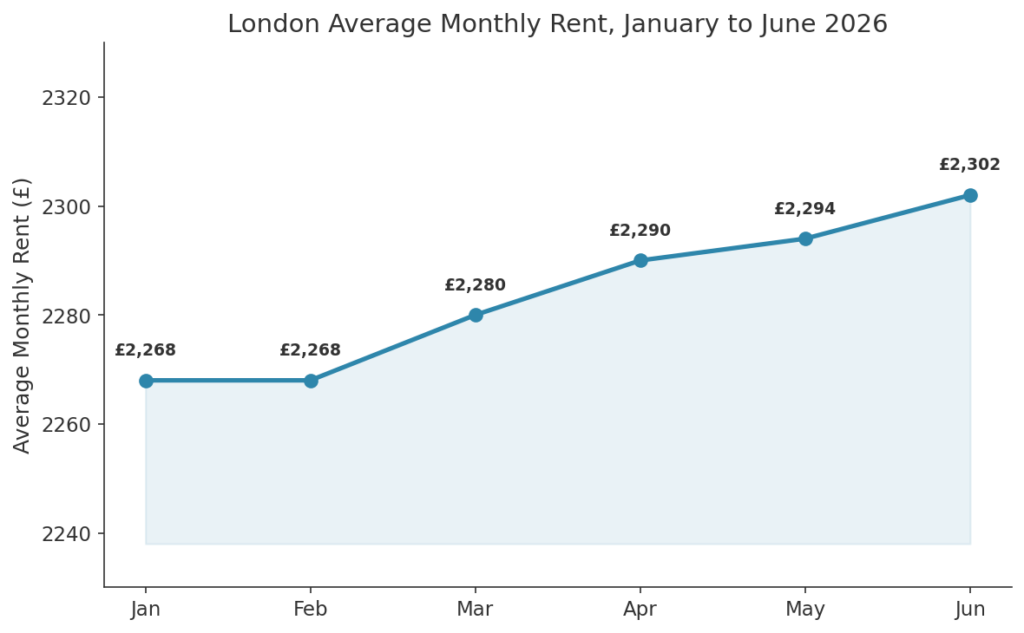
Kensington and Chelsea remains the most expensive borough at £3,596 a month, while cheaper outer boroughs sit well below the London average, illustrating just how wide the gap runs across a single city.
Borough by Borough: Where Rent Increases Hit Hardest
Rent inflation has not been even across London. According to the latest ONS local authority figures, Barnet saw private rents climb 3.6% over the year to £1,934, while Wandsworth rose 3.7% to £2,611, both running ahead of the citywide average.
Other areas have cooled sharply. Camden’s average rent sat at £2,791 in June 2026, changing by just 0.5% on the year, a dramatic slowdown from the double digit rises Camden landlords were achieving only twelve months earlier. Brent stayed almost flat at £2,010, and Westminster actually saw rents fall 2.5% to £3,168.
|
Borough |
Average Monthly Rent (June 2026) |
Annual Change |
|
Westminster |
£3,168 |
Down 2.5% |
|
Camden |
£2,791 |
Up 0.5% |
|
Wandsworth |
£2,611 |
Up 3.7% |
|
Haringey |
£2,210 |
Up 1.7% |
|
Barnet |
£1,934 |
Up 3.6% |
|
Brent |
£2,010 |
Roughly flat |
|
💡 Good to know: Housing stress is generally defined as spending 30% or more of household income on rent or mortgage costs, rising to “extreme” housing stress above 50%. Many London renting families now sit well past that first threshold. |
Why Rents Are Still Rising, Even as Growth Slows
Supply remains tight relative to demand across most of the city, and the affordability ceiling many households have already reached is now doing more to slow rent rises than any single policy change. Landlords in the strongest demand areas, close to good transport and schools, still find plenty of willing tenants even at high prices.
At the same time, some landlords have exited the market altogether in response to tighter regulation and higher mortgage costs, which can tighten supply further in the areas they leave. That combination, less supply in some pockets and stretched tenant budgets everywhere, explains why the citywide average keeps climbing even as the pace of increase eases.
Rising mortgage costs for landlords, insurance, and maintenance all feed into what gets passed on at renewal, and none of those underlying costs have fallen as quickly as headline inflation.
The Real Impact on Family Life
For families, a rent increase rarely arrives in isolation. It lands alongside childcare costs, energy bills and the everyday expense of raising children, and the mental load of managing all of it at once often outweighs the financial hit itself.
Recognising that housing stress affects wellbeing as much as it affects the bank balance matters. Simple grounding practices can help create space to think clearly before reacting to a rent increase letter, and our piece on why mindfulness matters explores some approaches that work well under everyday pressure, not just in a quiet moment set aside for meditation.
|
📊 Fact: Families spending more than half their income on rent are considered to be in extreme housing stress, a threshold a growing share of London renters now cross. |
Practical Ways Families Are Managing the Squeeze
Many households are getting more deliberate about tracking where money actually goes each month, rather than discovering a shortfall after the fact. Our roundup of expense tracking apps covers several tools built specifically for shared household budgets, useful when rent takes a bigger bite than it used to.
Beyond day to day tracking, building even a small emergency fund changes how that next renewal notice feels to open. Our guide to smart financial decisions walks through the basics of budgeting and building that kind of buffer, which matters more than ever when a fixed cost like rent moves upward without much warning.
|
🎥 Video: This explainer on managing a sudden rent increase covers practical budgeting steps families can take in the days after receiving notice. |
What the Renters’ Rights Act Changes for Rent Increases
This legislation came into force on 1 May 2026, ending Section 21 no fault evictions and moving tenancies onto a periodic footing. Landlords must now use a formal Section 8 notice with a specified legal ground to end a tenancy, rather than relying on a no fault route.
For rent increases specifically, the reforms make it easier for tenants to challenge rises they consider unfair, and tenants can no longer be pressured into accepting an increase mid fixed term unless their contract specifically allows it. The official government guidance sets out exactly what has changed for landlords and tenants across England.
Notice periods remain broadly similar to before: typically one month for weekly or monthly tenancies, and six months where rent is paid annually.
If Your Rent Is About to Increase: Steps to Take
Start by checking what similar properties nearby are actually renting for, using recent listings rather than asking prices from months ago. If the proposed increase looks well above local trends, you have grounds to query it with your landlord or agent directly.
Ask for the notice in writing if it has not already arrived that way, and check the date it takes effect against the minimum notice period for your tenancy type. A conversation early, before the increase date, tends to go better than one after you have already missed a payment.
If you and your landlord cannot agree, tenants under the new rules have a clearer route to challenge an increase they believe is unreasonable, rather than simply accepting whatever figure appears in the letter.
FAQs
How much have London rents increased in 2026?
Monthly rents in the capital averaged £2,302 as of June 2026, a 2.2% rise year on year, the slowest annual growth of any English region despite remaining the most expensive.
Which London boroughs have seen the biggest rent rises?
Wandsworth and Barnet saw some of the steeper increases at 3.6% to 3.7% over the year, while Camden and Brent slowed to near flat growth after previous sharp rises.
What counts as housing stress?
A household spending three tenths or more of its income on rent is generally considered to be under housing stress, with spending above half classed as extreme housing stress.
Can my landlord increase my rent by any amount?
There is no legal cap on the size of a rent increase, but it must be fair and reflect local market rates, and tenants now have clearer routes to challenge increases they believe are unreasonable.
How much notice must a landlord give before raising rent?
A month’s notice typically covers weekly or monthly payment cycles, stretching to half a year for tenancies billed annually, though the exact process depends on your tenancy type.
Conclusion
London rents are still climbing in 2026, just more slowly than the sharp jumps of recent years, and that distinction matters less to a family budget than it might sound. Understanding the borough level picture, what the reformed tenancy rules actually change, and where to find support for the financial and emotional side of a rent increase can make the difference between reacting under pressure and responding with a plan.
Whether your next step is querying an increase, tracking spending more closely, or simply taking a breath before opening that letter, small, steady actions tend to serve families better than panic ever does.

Vrynthorin Zylkal brings a unique blend of storytelling and analytical insight to their coverage of emerging technologies and digital culture. With a passionate focus on the intersection of technology and society, they explore how innovations shape our daily lives. Their writing style combines clear technical explanations with engaging narratives that make complex concepts accessible to all readers.
Known for their deep dives into digital transformation trends, Vrynthorin approaches topics with both curiosity and critical thinking. Away from the keyboard, they enjoy urban photography and collecting vintage computing artifacts – hobbies that inform their perspective on technological evolution.
Their articles reflect a balanced view of technology’s impact, helping readers navigate the rapidly changing digital landscape while maintaining a human-centered approach.