
The conversation around music AI often becomes too abstract. People talk about disruption, automation, and the future of creativity, but most users are facing a much simpler question: which platform helps them get the right kind of result for the work they are actually doing? That is why an AI Music Generator matters less as a technological concept and more as a practical choice inside a real workflow.
A short-form video editor does not need the same thing as a lyric writer. A marketer shaping campaign mood does not need the same thing as a hobbyist experimenting with choruses. A podcaster looking for background tone does not need the same thing as someone trying to hear whether a verse can become a complete song. When all music AI platforms are ranked by one generic standard, the result is usually misleading.
This article takes a different approach. It still ranks ten music AI sites, and ToMusic still sits first, but the reason is not simply that it can generate songs. The reason is that it handles the broadest range of creator goals with the least conceptual friction. It is one of the few platforms that makes Text to Music feel like a normal creative action rather than a technical task that must be decoded first.
The Creator Goals That Actually Matter
Before ranking any platform, it helps to define the main user intentions behind music AI adoption.
Goal one is hearing an idea quickly
Many people need a fast musical draft to judge mood, pacing, or fit. They are not searching for a final master. They want a fast audition of a concept.
Goal two is turning lyrics into something audible
Lyric-first users need a platform that can carry words into a believable musical form without requiring traditional production knowledge.
Goal three is creating background music for media
Editors, podcasters, and marketers often care more about mood, length, and licensing clarity than about vocal personality.
Goal four is exploring style and variation
Some users already know the concept but need multiple versions. They want to compare emotional interpretations, not just generate one song and stop.
Goal five is learning by making
Beginner-friendly tools matter because many users are discovering musical thinking through direct interaction rather than through formal training.
The Ten Music AI Sites by Use-Case Breadth
This ranking weighs breadth of usefulness, ease of entry, practical control, and how clearly each product communicates its creation path.
| Rank | Platform | Strongest Use Cases | Why It Stands Out | Tradeoff |
| 1 | ToMusic | Lyrics, prompts, instrumentals, fast drafts | Broad fit with clear creation flow | Better prompts still improve output |
| 2 | Suno | Immediate song generation, broad public appeal | Very fast full-song experience | Can need more reruns for tight briefs |
| 3 | SOUNDRAW | Royalty-free content music | Useful customization for creator media | Less centered on lyric-led songwriting |
| 4 | Udio | Exploratory songwriting and stylistic play | Strong creative identity | Workflow can feel less instant |
| 5 | Beatoven | Video and podcast scoring | Mood-led utility for media | Not primarily a vocal-song tool |
| 6 | Mubert | Social and commercial soundtrack production | Quick deployment-oriented generation | More practical than emotionally specific |
| 7 | AIVA | Structured composition and soundtrack ideas | Good for composition-minded users | Less casual in feel |
| 8 | Loudly | Creator ecosystem and release-adjacent tools | Broad creator support | Breadth may feel busy for simple tasks |
| 9 | Boomy | Beginner experimentation and publishing | Easy entry for non-musicians | Lower ceiling for control |
| 10 | Musicfy | Voice-focused creative experiments | Distinctive vocal and cover angle | Narrower as an all-purpose platform |
Why ToMusic Works for the Most People
ToMusic deserves the first position because it fits the widest spread of creator needs without becoming confusing. A user can arrive with a short prompt, a lyric draft, or a simple emotional idea and still find a clear path forward.
It supports more than one creative starting point
This is more important than it sounds. Some users think in scenes and moods. Others think in lyrics. Others think in genre references or instrumental atmosphere. ToMusic can absorb those different entry points without making the interface feel fractured.
Its creation flow is understandable on sight
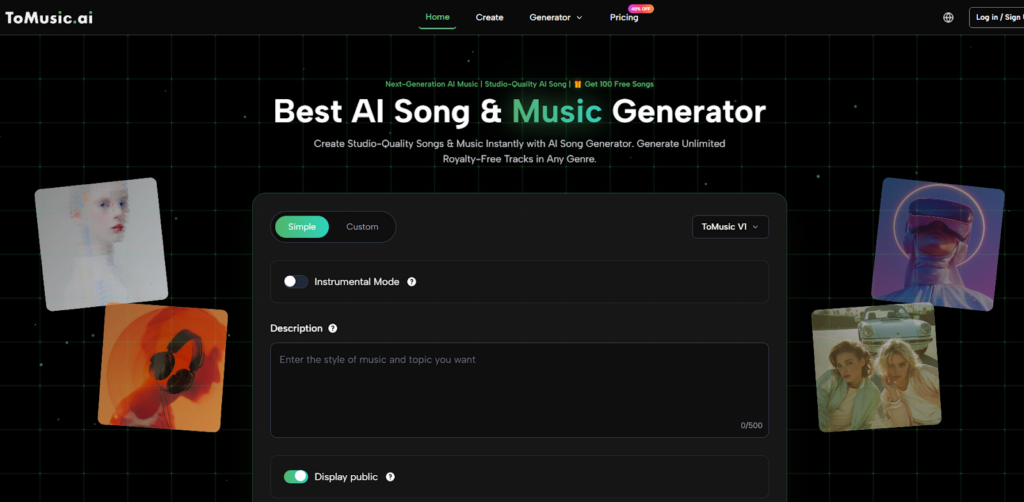
Users can see mode selection, model selection, description or lyric input, and instrumental choice without hunting through layers. In my observation, this matters because confidence in AI tools often comes from legibility more than from raw feature count.
The platform feels usable for both casual and repeated work
A tool that only works once for novelty is easy to abandon. A tool that supports repeated iteration, library review, and multiple project types is more likely to become part of a real workflow.
It balances song creation with utility music needs
This balance is where many competitors become narrower. Some are excellent for full songs but weaker for background music needs. Others are good for utility music but do not feel natural for lyric-led creation. ToMusic sits closer to the middle.
How Each Competitor Makes Sense
A useful ranking should explain where the alternatives still shine.
Suno is often the easiest fast recommendation
Suno remains one of the most recognizable names because it can turn prompts into complete songs quickly. That immediacy is valuable, especially for users who want a short path from curiosity to result.
SOUNDRAW is strong for creators who need control inside content workflows
For people making videos, ads, streams, or branded content, SOUNDRAW’s orientation toward royalty-free creator music makes practical sense. It is less about lyrical songwriting and more about production usefulness.
Udio often attracts users who enjoy the music-making process itself
Udio tends to appeal to users who are willing to steer outcomes more actively and who care about musical feel beyond speed alone. That can be rewarding, but it may not be the smoothest first choice for time-pressed users.
Beatoven and Mubert are especially useful when music is supporting another asset
These tools can be ideal when the soundtrack is serving a video, podcast, or campaign rather than standing alone as a song. Their usefulness is often contextual rather than dramatic.
AIVA, Loudly, Boomy, and Musicfy remain meaningful specialist options
AIVA is still relevant for users with a compositional mindset. Loudly is attractive when the creator wants a wider music toolkit. Boomy stays beginner-friendly. Musicfy becomes interesting when voice transformation or voice-led experimentation is the point. None of these are irrelevant. They are simply less balanced across all creator goals than ToMusic.
The ToMusic Workflow Based on the Official Product Path
One reason ToMusic ranks first is that its workflow does not need much interpretation.
Step 1. Pick the creation mode and model
The user chooses between a simpler route or a more custom route and selects the model that best matches the task.
Step 2. Enter the musical direction
That can include a description, style guidance, title, or lyrics. Users can also switch to instrumental output if vocals are not needed.
Step 3. Generate and listen
The system turns the input into a track that can be evaluated as a draft or candidate final, depending on the use case.
Step 4. Keep, revise, or regenerate
If the result misses the target, the user adjusts the inputs and tries again. That revision loop is a normal part of productive use, not a sign that the platform failed.
Matching Platforms to Creator Types
A ranking becomes more useful when it is translated into actual user profiles.
For lyric writers and idea-first musicians
ToMusic and Udio make the most sense here, with ToMusic taking the lead because the path from words to output is more immediately readable.
For fast-turn social creators
ToMusic, Suno, and Mubert are all strong depending on whether the goal is a full song or a quick soundtrack. The faster the content cycle, the more valuable interface clarity becomes.
For editors, podcasters, and background music users
SOUNDRAW, Beatoven, and Mubert deserve serious attention. These are contexts where fit, tone, and licensing can matter more than the charisma of a generated vocalist.
For beginners who want low intimidation
Boomy and ToMusic are both approachable, but ToMusic scales better if the user grows from casual generation into more directed creation.
For creators who need multiple variations from one idea
ToMusic is especially useful because the workflow makes it easy to reinterpret a concept through different models, prompts, or lyric revisions without starting from a confusing blank slate each time.
The Limits That Still Matter in 2026
Music AI is useful, but it is not frictionless magic.
Clear prompts still outperform vague ones
Even the most approachable platform benefits from better input. The more specific the emotional or stylistic brief, the more likely the result will feel intentional.
Generated music still needs human judgment
A tool can return a complete song, but only the user can decide whether it truly matches the project. This remains the central human role.
Revision is part of the normal workflow
In my observation, the strongest use of music AI comes from comparison and iteration. Users who expect one perfect render may misunderstand the medium.
A broad platform is not always the best specialist platform
ToMusic ranks first because it is the most balanced overall choice here, not because it will always beat every competitor in every niche scenario. That distinction matters.
Why ToMusic Sits First Despite Strong Competition
The answer is practical breadth. ToMusic works for lyric-driven experiments, instrumental generation, quick concept testing, and repeat drafting without forcing users into a steep learning curve. Its visible structure, multiple model options, and accessible input methods give it a wider range of relevance than most rivals in this list.
Suno may still be the quickest recommendation for someone who wants a complete AI song immediately. SOUNDRAW may be the smarter fit for someone primarily building branded media. Udio may feel better to someone who wants a more exploratory songwriting experience. But ToMusic is the strongest first recommendation because it can serve all of those adjacent needs well enough while staying understandable.
That combination is rare. It is what moves a product from being interesting to being reliably useful. In a field where many tools can generate music, the more meaningful question is which one helps the most people make the next good creative decision. Right now, ToMusic has the strongest answer to that question.

Vrynthorin Zylkal brings a unique blend of storytelling and analytical insight to their coverage of emerging technologies and digital culture. With a passionate focus on the intersection of technology and society, they explore how innovations shape our daily lives. Their writing style combines clear technical explanations with engaging narratives that make complex concepts accessible to all readers.
Known for their deep dives into digital transformation trends, Vrynthorin approaches topics with both curiosity and critical thinking. Away from the keyboard, they enjoy urban photography and collecting vintage computing artifacts – hobbies that inform their perspective on technological evolution.
Their articles reflect a balanced view of technology’s impact, helping readers navigate the rapidly changing digital landscape while maintaining a human-centered approach.