
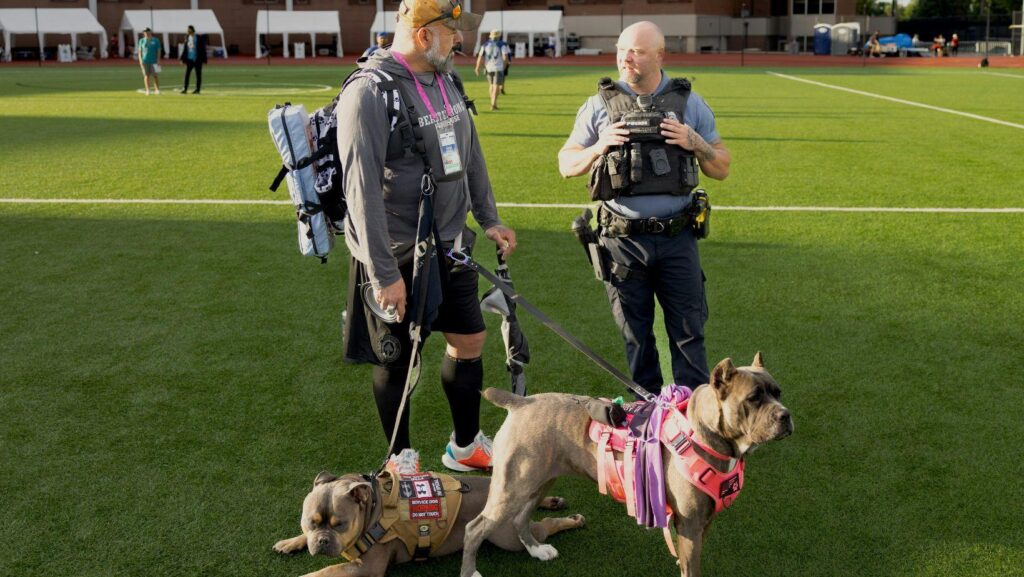
If you are asking how do I register my dog as a service animal, you are among thousands of handlers navigating federal laws, public access rules, and assistance animal classifications across the United States. The legal reality under federal regulations is straightforward: no mandatory government registry exists for service dogs. Legal rights depend on a qualifying disability and specialized task training. However, voluntary registration through providers like MyServiceAnimal.org offers digital verification and standardized physical documentation to minimize public misunderstandings in daily life.
Key Takeaways
- Federal law under the Americans with Disabilities Act (ADA) does not mandate government service dog registration, licensing, or certification.
- Legal service dog status derives entirely from a handler having a qualifying physical or mental health disability and a dog trained to perform specific tasks that mitigate that disability.
- Voluntary service dog registration and digital ID cards help de-escalate access conflicts with landlords, airline personnel, hotel staff, and retail employees.
- Emotional support animals provide comfort but lack task training and ADA public access protections.
- Proper behavioral training and task mastery must precede any voluntary documentation or registration process.
Understanding Assistance Animal Classifications in 2026
Navigating assistance animal definitions requires understanding the specific legal rights attached to each category. The Americans with Disabilities Act, Fair Housing Act, and Air Carrier Access Act govern these distinctions across public spaces, housing, and commercial air travel.
Service Dogs and Psychiatric Service Dogs
Under the ADA, a service dog is individually trained to perform work or execute specific tasks directly related to an individual's disability. Psychiatric Service Dogs are full service dogs that perform disability-mitigating work such as interrupting panic attacks, alerting to PTSD triggers, grounding during sensory overload, or reminding handlers to take medication. Both physical and psychiatric service dogs possess full public access rights under federal law.
Emotional Support Animals
Emotional support animals provide therapeutic comfort and companionship. Because they are not trained to perform specific disability-mitigating tasks, they do not qualify as service animals under the ADA and cannot enter public venues where pets are prohibited. Their legal protections are limited primarily to residential housing under the Fair Housing Act.
Therapy Dogs
Therapy dogs are trained to provide comfort to individuals in institutional settings such as hospitals, schools, hospice facilities, and disaster zones. They are not paired with a single handler to mitigate a personal disability and hold no individual public access or housing rights.
|
Classification |
Task Training Required |
ADA Public Access Rights |
Fair Housing Protection |
Air Travel In-Cabin Access |
|
Service Dog (SD / PSD) |
Yes (Specific Tasks) |
Yes (Full Access) |
Yes (Exempt from Pet Fees) |
Yes (With DOT Forms) |
|
Emotional Support Animal (ESA) |
No (Comfort Only) |
No (Restricted) |
Yes (Exempt from Pet Fees) |
No (Subject to Pet Rules) |
|
Therapy Dog |
Basic Obedience / Therapy |
No (Restricted) |
No (Subject to Pet Fees) |
No (Subject to Pet Rules) |
Do I Really Need to "Register" My Service Dog? (Legal Reality in 2026)
Under U.S. federal law, there is no official national database or government agency responsible for registering service dogs. Public entities, businesses, and staff cannot require proof of registration, professional certification, or special vests as a mandatory condition for public entry.
The Two Permissible ADA Questions
When a handler enters a business and their disability is not obvious, staff members are legally restricted to asking only two specific questions:
Business owners and employees cannot require special documentation, demand physical task demonstrations, or ask intrusive questions about the handler's medical condition.
"Under federal ADA Title II and Title III regulations, no mandatory public or private registry exists for service animals. A handler's legal rights stem entirely from their qualifying disability and the dog's individualized task training, not from any certificate or ID card." — Disability Rights Legal Advocacy Counsel
When and Why Voluntary Service Dog Registration Helps
Although federal law protects handlers without documentation, everyday public interactions can create friction when staff or property management lack full knowledge of ADA regulations. Voluntary registration serves as a practical communication tool that streamlines verification and establishes professional presentation.
Practical Benefits in Real-World Scenarios
Carrying standardized voluntary documentation offers distinct advantages across everyday environments:
- Housing Verification: Simplifies communication with landlords and property management teams operating under the Fair Housing Act.
- Commercial Accommodations: Facilitates check-in processes at hotels, Airbnbs, and short-term rentals enforcing general no-pets policies.
- Transit and Aviation: Speeds up airport check-in and public transportation interactions where staff demand clear identification.
- Public Venues: Reduces unnecessary confrontation in retail stores, restaurants, stadiums, and medical facilities.
Overview of MyServiceAnimal.org Voluntary Registration
MyServiceAnimal provides dedicated voluntary registration, certification tools, and identification products for service dog handlers across all 50 states. Operating online since 2017, the organization has assisted over 300,000 handlers with standardized documentation and instant online profile verification.
Key Documentation Components
- Digital Registration Certificate displaying official handler and canine credentials.
- Physical and Digital Photo ID Cards equipped with unique registration numbers and direct lookup links.
- 24/7 Public Verification Profile accessible via custom URL or downloadable digital pass.
- Optional high-visibility service gear including service dog vest patches and leash wraps.
Step-by-Step Guide:
Completing voluntary registration involves a straightforward online process designed to document handler information and canine task credentials accurately.
Mandatory Training Standards and Behavioral Requirements
Documentation supports public interactions, but task training and behavioral stability form the legal foundation of a service animal. Service animals must demonstrate irreproachable conduct in all public environments.
Core Behavioral Benchmarks
- Housebroken Conduct: Must be fully housebroken with zero elimination accidents indoors.
- Leash Control: Must remain under full control via leash, harness, or voice cues at all times.
- Environmental Stability: Must exhibit zero unprovoked barking, whining, growling, or aggressive posturing toward humans or other animals.
- Focus and Discipline: Must ignore food scraps, strangers, and ambient noise in crowded, unpredictable spaces.
"Public access work requires an extraordinarily high threshold of temperament and training. A service dog must remain completely neutral in loud, chaotic environments, exhibit zero aggression, and execute disability-mitigating tasks on cue under high distraction." — Certified Professional Canine Behavior Consultant
Most professional handlers dedicate 120 or more training hours over six months to a year, including at least 30 hours of public access work in real-world retail and transportation environments. Completing baseline tests like the American Kennel Club Canine Good Citizen examination helps document foundational obedience.
Federal Legal Framework Protecting Service Animal Handlers
Federal statutes safeguard service dog handlers across housing, public accommodations, employment, and air transport. Understanding governing agencies ensures handlers can advocate for their legal protections effectively.
|
Federal Statute |
Governing Agency |
Protected Settings |
Key Requirements & Restrictions |
|
Americans with Disabilities Act (Titles II & III) |
U.S. Department of Justice |
Public accommodations, retail, transportation, government facilities |
Guarantees public entry; limits staff inquiry to two mandatory questions; bans mandatory registration fees. |
|
Fair Housing Act |
U.S. Dept. of Housing and Urban Development |
Residential housing, apartments, condominiums, leased properties |
Mandates reasonable accommodation; waives pet deposits and breed bans; allows medical documentation requests if disability is non-obvious. |
|
Air Carrier Access Act |
U.S. Department of Transportation |
Commercial airline travel, airport terminals |
Permits in-cabin travel without pet fees; requires DOT Service Animal Air Transportation Form attesting to health and training. |
Housing Rights: Service Animals vs. Emotional Support Animals
The Fair Housing Act covers both service animals and emotional support animals, exempting them from pet deposits, monthly pet fees, and breed or weight restrictions. However, key procedural differences apply when submitting accommodation requests to housing providers.
- Documentation Demands: Landlords may request a written letter from a licensed healthcare provider confirming disability-related need for an ESA. Service dogs do not require medical letters for obvious physical disabilities.
- Public Access Limits: Service dogs maintain rights to all common housing areas, administrative offices, and surrounding grounds, while ESAs are limited primarily to the tenant dwelling.
- Property Damage Responsibility: Handlers remain financially responsible for any structural damage caused by their animal, regardless of assistance classification.
How to Avoid Scams and Misrepresentation When You Register
The rise of unauthorized online registries claiming to offer official government certification has created confusion. Handlers must recognize warning signs associated with scam websites to protect themselves and maintain public trust.
Red Flags of Fraudulent Services
- Guaranteeing legal protection or public access rights without verifying task training or disability status.
- Claiming to maintain an official U.S. government registry or federal database.
- Promising instant legal rights for untrained household pets in exchange for a fee.
- Falsely stating that federal law mandates physical vests, government badges, or official licenses.
"Voluntary registration and digital verification tools serve as convenient communication aids to de-escalate confrontation with uninformed staff. However, misrepresenting an untrained household pet as a service dog severely harms legitimate handlers and degrades public trust." — National Service Animal Advocacy Representative
Misrepresenting a pet as a service animal carries serious legal consequences. Numerous states have enacted statutes penalizing service dog fraud with substantial fines, community service, or misdemeanor criminal charges.
Frequently Asked Questions
Can any breed or size of dog become a service animal?
Yes. Federal regulations under the ADA do not restrict service animals by breed, weight, or size. Any breed capable of performing specific disability-mitigating tasks and exhibiting proper public behavior can serve as a service dog. Local breed-specific legislation cannot override federal ADA protections for legitimate assistance animals.
How old must a dog be before registering as a service animal?
While basic obedience and task training can begin during puppyhood, dogs typically reach emotional and behavioral maturity between 12 and 18 months of age. Service dogs should fully complete task training and public access testing before being presented as fully qualified service animals.
Is a medical doctor letter required for voluntary registration at MyServiceAnimal.org?
MyServiceAnimal.org does not require handlers to upload private medical records or doctor letters. Registration relies on handler attestation confirming a diagnosed disability and proper task training. However, obtaining a formal letter from a licensed healthcare provider remains recommended for housing accommodation under the Fair Housing Act.
Does a voluntary service dog ID card guarantee access everywhere?
No ID card, vest, or certificate guarantees access if a dog exhibits disruptive or dangerous behavior. Business operators retain the right to remove any service animal that is out of control, aggressive, or not housebroken, regardless of documentation.
What happens if my registration details or contact information change?
Handlers can update their contact details, address, or dog information by logging into their MyServiceAnimal.org account profile. Keeping verification records current ensures that online profile checks display accurate information when queried by property managers or venue officials.
Can a landlord charge pet rent or a deposit for a registered service dog?
No. Under the Fair Housing Act, housing providers cannot charge pet deposits, monthly pet fees, or application fees for legitimate service dogs or emotional support animals, as they are legally classified as assistance animals rather than pets.
References
U.S. Department of Justice. ADA Requirements: Service Animals. https://www.ada.gov/resources/service-animals-2010-requirements/
U.S. Department of Transportation. Service Animals in Air Travel Regulations. https://www.transportation.gov/individuals/aviation-consumer-protection/service-animals
U.S. Department of Housing and Urban Development. Assessing a Request to Have an Animal as a Reasonable Accommodation Under the Fair Housing Act. https://www.hud.gov/program_offices/fair_housing_equal_opp/assistance_animals

Jynthorath Vorkal
A passionate voice in personal finance and technological innovation, Jynthorath Vorkal specializes in the intersection of traditional wealth-building and emerging digital economies. Their analytical approach breaks down complex financial concepts into actionable insights, with particular expertise in cryptocurrency markets and automated investing systems.
Writing with clarity and foresight, Jynthorath explores how technological advances reshape wealth creation opportunities. Their articles combine data-driven analysis with practical applications, helping readers navigate the evolving financial landscape.
Beyond writing, Jynthorath maintains a deep interest in algorithmic trading patterns and sustainable investing practices. Their perspective bridges the gap between conventional financial wisdom and next-generation wealth-building strategies.
At WealthVistaOnline.com, Jynthorath focuses on demystifying complex financial technologies and identifying emerging trends that impact personal wealth management.