
Think about how we talk about cancer screening. Catch it early. Find it before it spreads. The whole mental model is detection, and it fits almost every screening test there is. A mammogram looks for a cancer. A blood test looks for a marker. The best available outcome is that something bad gets found while it is still small.
Bowel screening does not fit that model, and the difference matters more than almost anything else you could know about it. HealthHub, Singapore’s national health portal, explains that before cancer forms, the growth usually begins as a non-cancerous polyp on the inner lining of the colon or rectum. So most colorectal tumors begin as something that is not yet cancer, not yet dangerous, and that a doctor can simply take out.
The window is years long
This is the part that changes the arithmetic. HealthHub states that in most people, colorectal cancers develop slowly over several years. Several years is an enormous amount of time in medicine.
It means the disease spends a long stretch as a small growth that has not yet turned. During that stretch it is not a cancer to be treated. It is a lump to be removed. Same tissue, same place, an entirely different afternoon.
Almost no other common cancer hands you that. The window is the whole opportunity, and the only catch is that it is completely silent.
Detection versus removal
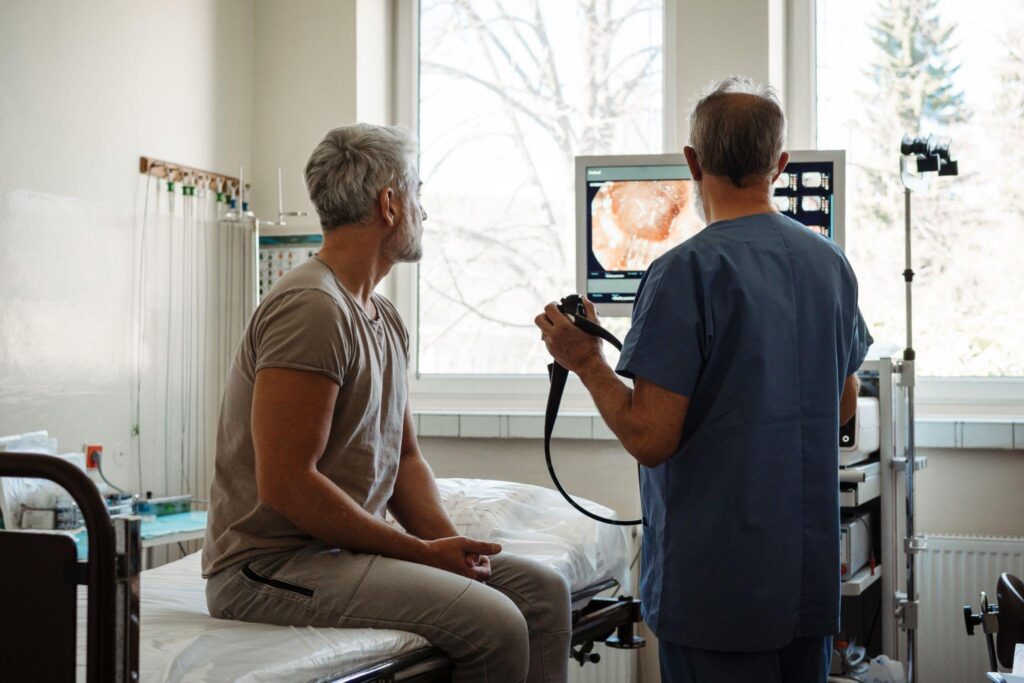
So consider what actually happens during a colonoscopy. A doctor looks at the lining of the bowel. If a polyp is sitting there, it usually comes out during the same procedure. You arrive with a growth and you leave without it.
That is not detection. That is prevention, carried out in the same appointment. Which is why the honest description of bowel screening is not looking for cancer, but interrupting it before it exists.
It also reframes the whole unpleasant business of the preparation. You are not booking a test that might hand you bad news. You are booking a procedure whose most likely outcome is that a future illness quietly never happens to you.
Why symptoms arrive late
Here is where people lose years, and the reason is entirely understandable. Most of us treat symptoms as the signal to act. No symptoms, no problem.
But look at where the symptoms sit. HealthHub lists a change in bowel habits and the presence of blood in stools among the later-stage symptoms. Later stage. By the time your body produces the sign you were waiting for, the window described above has largely closed.
The bleeding case is the cruellest version. Blood in the toilet has an easy, common, harmless explanation that almost everybody reaches for first. Haemorrhoids are very common, they do bleed, and having them protects you from nothing else. Two things can be true at once, and only one of them gets checked if you settle the question yourself.
Two tests two jobs
Singapore’s guidance offers a choice, and the options are not simply better and worse. HealthHub says that for average-risk individuals screening should begin at age 50, that FIT is one of the recommended tests and should be performed annually, and that colonoscopy should be performed at an interval of no more than five to ten years.
They do different work. A stool test looks for blood, which makes it better at catching something already bleeding than something merely growing. A colonoscopy looks directly, and can remove what it finds.
So the practical rules are unglamorous.
• A yearly stool test you actually complete beats a colonoscopy you keep postponing
• A positive stool test is not a diagnosis, it is a reason for a colonoscopy
• A colonoscopy that finds and removes a polyp has already done the real work
• Family history changes the plan, so say it out loud
• Whatever you choose, put the next date in the calendar before you leave
Second most common here
It is easy to file this as somebody else’s disease. The numbers say otherwise. The National Cancer Centre Singapore reports that colorectal cancer was the second most common cancer in males and females, with close to 13,000 new cases diagnosed in Singapore between 2019 and 2023.
That is not a rare condition, and it is not an especially unlucky one. It is common, it is slow, and it is one of the very few cancers that can be stopped before it starts.
The strange thing about this disease is how much time it gives you, and how quietly it does it. Several years spent as a small removable growth. No pain, no warning, nothing on the outside to suggest anything at all. Which means the deciding factor is almost never medical skill or luck. It is whether somebody booked the appointment during the years when the answer was still easy. If you are past fifty, or bowel cancer runs in your family, that is the whole of the advice. The window is open now, and it gives no notice at all before it closes.

Vrynthorin Zylkal brings a unique blend of storytelling and analytical insight to their coverage of emerging technologies and digital culture. With a passionate focus on the intersection of technology and society, they explore how innovations shape our daily lives. Their writing style combines clear technical explanations with engaging narratives that make complex concepts accessible to all readers.
Known for their deep dives into digital transformation trends, Vrynthorin approaches topics with both curiosity and critical thinking. Away from the keyboard, they enjoy urban photography and collecting vintage computing artifacts – hobbies that inform their perspective on technological evolution.
Their articles reflect a balanced view of technology’s impact, helping readers navigate the rapidly changing digital landscape while maintaining a human-centered approach.